Introduction
Bluetooth® Auracast™ is a next-generation standard poised to fundamentally change the conventions of wireless audio. Rather than the one-to-one pairing that traditional Bluetooth has always required, it introduces a new broadcast model in which a single transmitter delivers audio to a large number of receivers simultaneously.
Beyond public information use cases such as airports, theaters, and museums, this technology holds real promise for broadcast production environments where failure is simply not an option. This article introduces the technical background of Auracast, its key characteristics, and its practicality for professional applications.
The Evolution of Bluetooth® and the Birth of Auracast™
Bluetooth technology has been widely known since the 2000s, used extensively for audio transmission in wireless headsets and speakers. It came, however, with significant constraints around power consumption and connection methods.
Bluetooth Low Energy (BLE), introduced in 2010, achieved ultra-low power consumption and gave a major boost to the spread of IoT devices. Bluetooth 5.0 subsequently brought large improvements in communication range and speed, further maturing the technology.
Then, with Bluetooth 5.2, a new-generation audio standard called “LE Audio” was introduced. Its adoption of the highly efficient LC3 codec together with a new synchronized transmission scheme — LE Isochronous Channels (LE ISOC) — made Auracast possible.
In Auracast, a transmitter broadcasts audio in one direction, and receivers select and receive that broadcast — much like a radio. This mechanism allows a large number of users to listen to the same audio simultaneously.
High-Precision Synchronized Transmission Enabled by LE Isochronous Channels
LE Isochronous Channels (LE ISOC) is the key technology underpinning Auracast.
Conventional data communication ensures reliability by retransmitting lost packets. For audio transmission, however, excessive retransmission introduces delay and disrupts playback timing.
LE ISOC instead prioritizes sending data at fixed intervals, with a design that emphasizes real-time performance. This allows audio to be delivered while maintaining extremely high synchronization accuracy across multiple receivers.
Auracast also uses Periodic Advertising (PA) to eliminate the pairing process that was previously required. Receivers automatically discover nearby broadcasts, and users simply select their desired channel from a list to receive audio.
Auracast further supports multiple simultaneous audio streams and multilingual distribution, opening up applications ranging from simultaneous interpretation to event services.
Bluetooth’s Strength in Overcoming Congested RF Environments
At large venues such as exhibition halls and stadiums, numerous Wi-Fi access points and wireless devices operate simultaneously, and RF interference becomes a significant challenge.
One reason Bluetooth maintains high reliability is Adaptive Frequency Hopping (AFH).
Bluetooth communicates by rapidly switching among multiple channels in the 2.4GHz band. AFH goes a step further, automatically avoiding congested channels and dynamically selecting available ones to maintain stable communication.
Because timing and hopping patterns differ from network to network, the likelihood of sustained interference on the same frequency over an extended period is extremely low. This mechanism preserves high communication quality even in congested wireless environments.
The broadcast production system from NHK Technologies, distributed by Hibino Corporation, further adopts a high-output design and optimized antenna configuration, along with professional-grade interfaces such as XLR inputs suited to connection with broadcast equipment.
The Low-Latency Performance Broadcast Production Demands
Latency is an extremely important factor in broadcast production.
When cueing talent or signaling camera operators, any delay in audio can affect the entire operation on set.
This Auracast system offers multiple selectable latency modes depending on the use case. A dedicated low-latency mode achieves roughly 40ms of delay, a general cueing mode operates at roughly 60ms, and a high-fidelity mode operates at roughly 90ms.
These figures are made possible by the LC3 codec’s highly efficient processing combined with strict time-synchronization control.
Receivers also activate their receiving circuitry only when needed, substantially cutting power consumption — a mechanism that allows long-duration operation without sacrificing communication performance.
Practicality Proven at BroadcastAsia
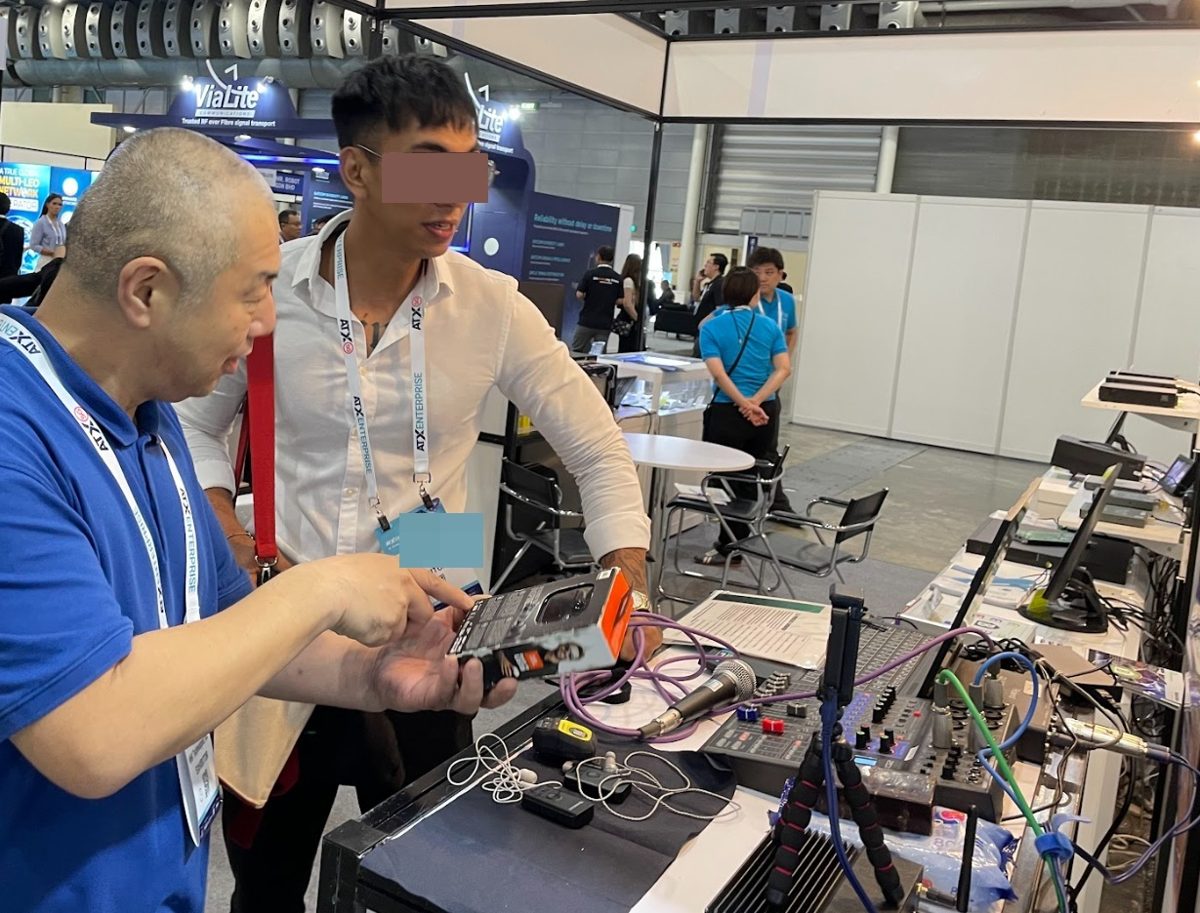
The system’s robustness was validated on an international stage during field testing at “BroadcastAsia,” the broadcast and media technology exhibition held as part of Asia Tech x Singapore (ATxSG) — one of Asia’s largest technology festivals — in Singapore in May 2026.
The test was conducted by NHK Technologies, with Village Island providing support on the exhibition environment and technical side.
The test environment presented an extremely demanding RF landscape, dense with numerous Wi-Fi access points and wireless devices. Even so, the system maintained stable audio transmission across the entire exhibition hall, and no practically significant audio dropouts were observed throughout the show.
Pre-show evaluation also confirmed transmission capability reaching adjacent halls, earning high praise from many broadcast professionals and engineers in attendance.
Its effectiveness was particularly recognized for “audio return” use cases — distributing a single director’s instructions to numerous staff members simultaneously.
Conclusion
Auracast significantly improves on the connectivity and scalability constraints of traditional Bluetooth, opening up new possibilities for wireless audio.
Simultaneous delivery to numerous receivers, high synchronization performance, strong interference resistance, and low latency create substantial value not only for general consumer applications but also for professional fields such as broadcast production and event operations.
As compatible devices continue to increase and use cases expand, Auracast is set to play an increasingly important role as a next-generation audio distribution foundation.
NHK Technologies, Inc.
Media Technology Division, TD & Systems Department
Hideyuki Suzuki
Village Island Co., Ltd.
President & CEO
Michael Van Dorpe
Village Island Co., Ltd.
Kowa Shirokanedai Bldg. 5F, 3-19-1 Shirokanedai, Minato-ku, Tokyo 108-0071, Japan
village-island.com
© 2026 Village Island Co., Ltd. All rights reserved.